It’s about tide!
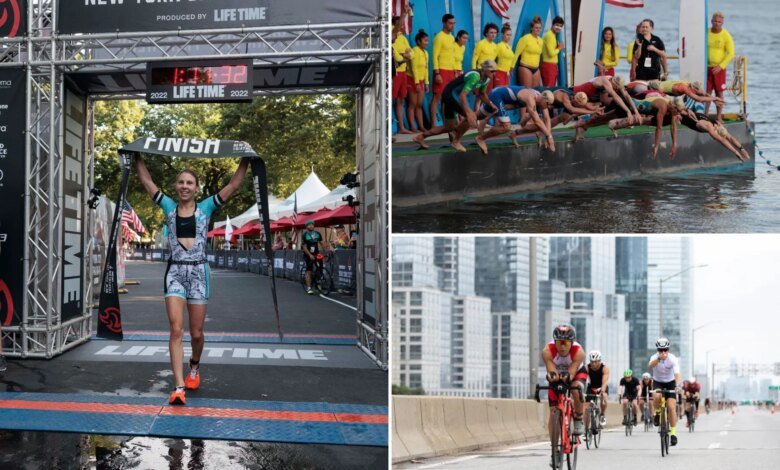
After two years of dormancy, the city’s only swim-bike-run event — now called the Big Apple Triathlon — will make a comeback Saturday with some 1,300 endurance enthusiasts expected to jump in (to the Hudson, that is).
If all goes to plan, athletes taking on the longest distance will stroke nearly a mile up the shoreline before riding 25 miles along the West Side Highway and striding 6.2 miles into and around Central Park.
The race, formerly known as the New York City Triathlon, has been around since 2001. But its recent history is notoriously choppy, soured by scheduling snafus and weather woes.
“I believe every edition since 2017, we either had to shorten the run, shorten the bike or cancel the swim,” former race director Alex De Gracia of Life Time told the Post. (His organization sold the race in 2023.)
In 2019, for example, the then-summer spectacle was nixed due to extreme heat. In 2021 and 2023, water quality concerns shuttered the swim and rerouted athletes to a run-bike-run. In 2022, a forecast in the 90s slashed the bike and run distances by at least half.
And, before 2024’s race even opened to registrants, organizers threw in the towel. While they’d tried to skirt scorching temps by moving the production to the fall, they and the city couldn’t land on a viable date. Local triathletes moved on.
But now, under the direction of yet another organizer, Alpha Win, and with an early fall date, the starting gun will sound again. And competitors — about half of whom are coming from outside the city and most of whom paid between $350 and $625 for the honor — hope this time’s the charm.
“I was super excited when I heard about it; I loved the New York City Triathlon,” said Matt Stern, a 32-year-old attorney in Manhattan who raced in 2023 and calls the course “epic.” “I think it’s amazing to be able to swim, bike and run in the city. You train here every day, so to actually be able to race here is awesome.”
Why tri?
A triathlon is any race featuring a swim, bike and run, usually in that order so athletes enter the water fresh, not fatigued. The shortest such feats, or “sprints,” often net out at 16 miles. The best-known long-course tri — an Ironman — covers 140.6 miles, including, famously, a marathon.
The city’s competition has long been an “Olympic” race, or basically double the length of a sprint. But this year’s production offers “a distance for everyone” — Alpha Win’s motto — including a sprint, relay, aquabike (swim-bike) and duathlon (run-bike-run).
“People associate the name ‘triathlon’ with Ironman, and they think, ‘Oh, that’s some crazy goal,’” Stern said. “But I think triathlon is really accessible for a lot of people.” He got hooked three years ago after joining his cousin for a sprint in Montauk. Back then, he could barely swim. Now, he’s an Ironman finisher and member of the Empire Tri Club.
“It’s fun to be able to push yourself, see what you can do, how far you can take yourself, how fast you can go,” Stern said. “And the community around you is what makes it really special.”
The sport attracts “not just your elite, very, very fit-looking people; it’s certainly a diversified group,” added Tommy Struzzieri, the CEO and race director of Alpha Win, which is based in Saugerties, New York, and has produced over 200 races since 2010. “That’s why I love standing at the finish line.”
But to get there in Gotham, a lot has to go right.
First, there’s the weather. “Racing in the northeast has a very limited window,” said Joel Volterra, a triathlon coach with TriLife NYC and one of this year’s competitors. In spring, the water’s too cold. In summer, the air can be too hot. In fall, the unlikely but real threat of hurricanes looms.
Then, there’s the city calendar. Just try finding a weekend day during that window that doesn’t have the local government tied up with a protest, parade, presidential visit or a playoff game.
Plus, unlike races pretty much anywhere else — where safe cycling doesn’t mean siphoning off a crosstown artery in Manhattan’s most populous ZIP code and where securing a swim doesn’t dictate a call to the Coast Guard — a multisport operation in the Big Apple requires the blessing of city, state and federal authorities.
“You’ve got DOT, you’ve got Parks, you’ve got police, you’ve got emergency services … you’ve got Riverside Park and Central Park, you’ve got all the community boards that are affected,” Volterra said. “So it’s any one of those things or a bad weather event [that] can derail it.”
There’s something in the water — or is there?
And yes, there is the Hudson. But before we talk trash, let’s talk tides.
“When people think of a river, they think of a river moving in one direction. That’s not what happens in the Hudson,” said Deanne Draeger, founder of Urban Swim, which hosts open-water swims around the city and advocates for more accessible waterways.
Rather, what happens in the Hudson — technically a “tidal estuary” — is a series of “tide cycles,” Draeger added. “It’s constantly flowing north and south, and north and south again. So that’s one of the most important things planners have to take into account.”
As such, this year’s swim route heads north to help participants go with the literal flow. Man-made barges mark the leg’s start and end.
A “safety flotilla” including 60 lifeguards on paddle boards, FDNY and NYPD boats and other vessels staffed with paramedics and rescue divers will shield the lane from marine traffic and save, if necessary, swimmers in distress.
The Big Apple Tri is “one of the fastest swims [in the sport], but that doesn’t mean we think every athlete is going to be 100% comfortable jumping in the Hudson,” Struzzieri said. “So we have to be prepared for all parts of that process.”
Indeed, a self-proclaimed beginner triathlete sought comfort from Reddit after signing up for this year’s challenge: “I’m training well for the swim and I’ve done a bit of open water practice but I am not sure that I am really mentally committed to swimming in the Hudson.”
But despite its radioactive reputation, the river often tests safe enough for swimming, Draeger said. Decades of wastewater improvements and federal regulations have drastically reduced pollution and cut “fecal coliform bacteria” in the New York Harbor by 95% since 1970, one 2007 report showed.
Since then, investments in the city’s sewage system, as well as efforts from nonprofits like the Billion Oyster Project, have revitalized water quality and ecology further. Without these upgrades, plus careful monitoring, Draeger’s group wouldn’t be able to safely guide about 200 swimmers in open-water events around the local waterways each year.
“The river isn’t just a pretty view; it’s public space. This is part of the city, which is one of the things that I think is fantastic about the New York City Tri,” said Draeger, who completed it in the past. “It’s an opportunity when people can get in the water, and you have an experience of New York City that’s completely different from anything that you’ve had before.”
That said, the Hudson is hardly a glacial spring. No one should be diving in outside of an organized event. And, in the wrong conditions, even such contests can present risk. Due to the city’s antiquated sewage system, experts say, heavy rainfall is enemy No. 1.
“After a big storm, all of the contamination that’s on the city streets from the pets, from the animals, from trash, gets flushed into the catch basins and over land into the water and goes through these outflows that the city is desperately trying to address,” said Volterra, a civil engineer by day.
But this year — gangrene-free fingers crossed — participants appear to be in the clear. The Department of Environmental Protection has been testing the river for months. Alpha Win has been consulting with an on-site meteorologist for weeks. The sky has stayed dry for days.
“So far,” Struzzieri said Monday, “so good.”
For a race that has spent years battling the elements, that’s a promising forecast.