Daughters of the American Revolution revolt — because trans zealots can’t leave ANYTHING alone

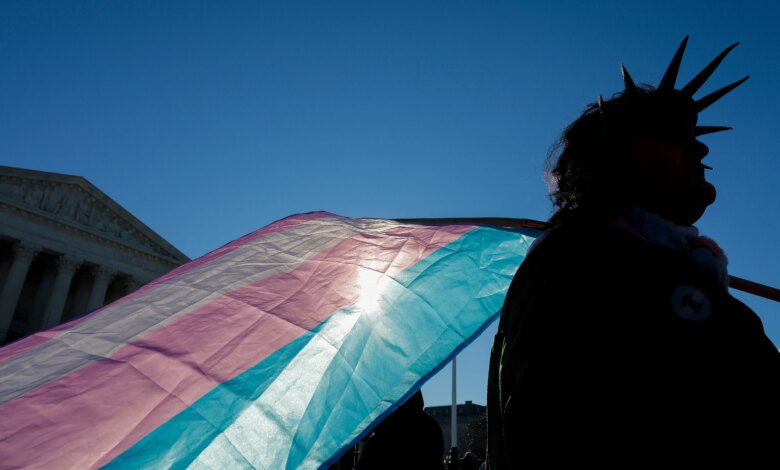
Last week the Daughters of the American Revolution marked America’s 250th anniversary not by honoring the nation’s Founders, but by miring itself in an unnecessary woke battle that threatens the organization’s very future.
Delegates at the DAR’s 135th Continental Congress in Washington, DC, this past weekend defeated a member-driven attempt to limit membership to those “born female” — that is, to actual daughters.
The vote means the group’s leaders will get their way: They can now open membership to anyone who considers themselves to be female.
The members’ resolution failed by a vote of 1,481 to 984 after a bitter procedural fight that many attendees say was engineered to produce exactly that outcome.
The Daughters, as they’re known, are women who can document direct descent from a patriot of the American Revolution.
It’s a women-only service organization that has offered leadership and educational opportunities to women since 1890.
For a century-plus, the DAR’s very name has described both who its members are and why they belong.
It’s difficult to imagine a more straightforward membership standard than one rooted in genealogy and biological reality.
Yet all that has now been thrown into question over what members estimate is a grand total of between two and five transgender members — out of 190,000 — who call themselves “Transdaughters.”
The voting process itself only deepened the divide.
The congress’ initial vote was scotched before it was counted, when opponents of the measure claimed to have seen evidence of cheating.
That launched a lengthy and convoluted second vote that required thousands of women to cast ballots one at a time — in a process that stretched for roughly 12 hours.
Delegates, many of them elderly, were effectively confined to the convention hall with only two bathroom breaks and no food service if they wanted their votes to count.
Consumed by this single issue, convention organizers canceled luncheon events, disrupted award ceremonies and pulled the plug on service projects honoring troops and veterans.
Intentionally or not, the process inevitably suppressed participation — and left many wondering whether exhaustion was part of the leadership’s strategy.
Erin, a California delegate who traveled across the country expecting a joyous celebration of America’s semiquincentennial, believes the vote threatens the continuity of an organization she cares about deeply.
“I didn’t really feel like going to anything the rest of the week,” she told me. “I was depressed. I was tapped out.”
The strife had an immediate impact on her monetary support for DAR.
Like many longtime members, Erin had planned to spend big on special DAR insignia and keepsakes celebrating the nation’s 250th birthday during the event — but she walked away empty-handed.
“I didn’t buy any merch this year, nothing,” she said.
“I’m not giving to them outside of my required dues. I am not giving them a penny.”
She says that sentiment has spread among many members who opposed the vote.
They’ll keep paying the minimum required to preserve their membership, but the voluntary spending, donations and enthusiasm that sustain organizations like the DAR are beginning to disappear.
That may ultimately be the vote’s real legacy.
Again and again, American institutions have discovered that appeasing ideological activists while ignoring the wishes of their core constituency is a losing strategy.
The customers leave, donors disappear, volunteers stop volunteering.
The institution slowly hollows itself out from within.
Yet again and again, left-leaning leaders fall for the same trap.
There’s a bitter irony in how an organization created to honor the sacrifices of America’s founders chose, on the eve of the nation’s 250th birthday, to jeopardize its own future over the wish to accommodate at most five people.
The biblical story of King Solomon reveals a timeless truth: The person willing to divide the child is rarely the one who truly loves the child.
The women fighting to preserve the DAR as a female organization aren’t the ones demanding that the institution change its identity.
No, those willing to fracture it over the demands of two to five wannabe members are demonstrating a reckless willingness to gamble the viability of an institution that has survived for 135 years.
King Solomon knew how to identify the true mother — the one who could not bear to see the child divided was the one who loved it most.
The Daughters have a thing or two to learn from the mother in that ancient tale.
Bethany Mandel writes and podcasts at The Mom Wars.