Utility company leader tells audience that data centers will extend fossil fuel usage

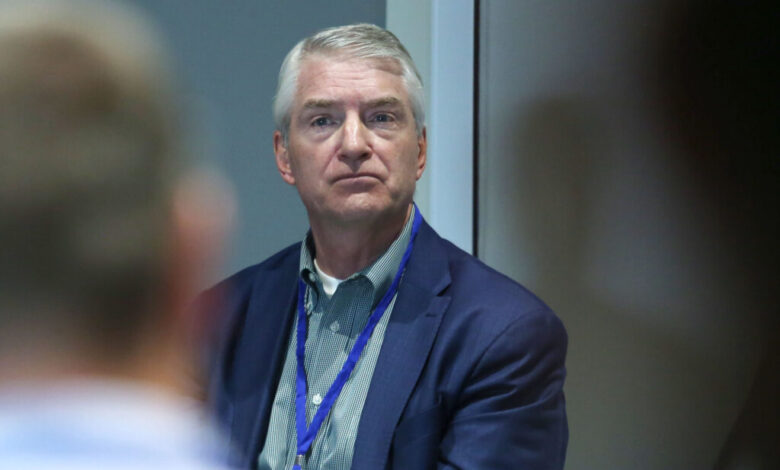
SIOUX FALLS (South Dakota Searchlight) — The rapid growth of electricity-hungry data centers will extend the life of existing fossil-fuel power plants and result in more being built, according to NorthWestern Energy President and CEO Brian Bird.
“So those folks against that are going to find everything they can to go after data centers,” he said.
Speaking Monday to the Downtown Sioux Falls Rotary Club, Bird acknowledged the potential environmental and climate-change impacts of data centers, but he also described them as an opportunity for utilities after years of relatively flat electricity demand.
Rooms or buildings full of computer servers have been storing cellphone pictures, emails and social media accounts for years. What’s new are 100- to 1,000-acre warehouses full of servers for artificial intelligence and cryptocurrency. Those massive data centers, which can require up to 1,000 megawatts of power, can have an electricity consumption equivalent to that of up to 800,000 residential customers. South Dakota’s largest data center consumes 30 megawatts, but much larger data centers have been proposed.
Data centers make up 4.4% of annual U.S. electricity consumption, a figure that could triple by the end of the decade, according to a Congressional Research Service report.
NorthWestern, which is headquartered in Sioux Falls, delivers natural gas and electricity to customers in the western two-thirds of Montana and eastern South Dakota. The company also has gas service in Nebraska and provides electricity to Yellowstone National Park. NorthWestern is in the midst of a merger with Black Hills Energy, motivated in part by the need to meet greater demand from data centers.
Bird said meeting data center needs will require on-demand power. He said that will largely come from coal and natural gas plants rather than from intermittent resources such as wind and solar.
He said emerging battery storage technologies are useful for short-term needs but don’t address reliability concerns in a region where demand spikes during extreme cold. He said batteries also perform worse in low temperatures.
Data center development could accelerate interest in nuclear power, he said, which is an industry that does not currently exist in South Dakota. That would provide a less carbon-intensive, on-demand energy source. Though he said if battery storage advances to around 100 hours of storage capacity, wind and solar paired with those batteries could create an environment where “maybe nuclear doesn’t even get that much attraction.” He said industrial-scale batteries have about four hours of storage currently.
Following the discussion, Bird told South Dakota Searchlight the demand for data centers will almost certainly be met somewhere, whether South Dakota welcomes them or not. He said that makes the increased fossil fuel use all but inevitable. And if not in the U.S., they could be built in a country with less stringent environmental standards.
Bird said the state should seek to capture the benefits of data centers, including jobs and millions in revenue from electricity sales taxes and property taxes.
Data center developers will not build in the state without a sales tax exemption on their software and hardware, Bird said. A state House Committee recently defeated a bill to provide exemptions, 9-3.
“There are some folks that think they can do maybe without the sales tax, but I haven’t found those people,” Bird said, referencing data center developers. “I’ve heard they’re out there.”
A spokesperson for a proposed 430-megawatt data center in South Dakota’s Deuel County estimated that, under the failed legislation, its facility would have received approximately $500 million in sales tax relief each time it updated its billions of dollars’ worth of hardware and software.
Wildfire mitigation
During the Rotary meeting, Bird also discussed pending state legislation that would provide utilities with wildfire liability protections, in exchange for filing a wildfire mitigation plan.
Under the bill, private utilities could submit mitigation plans to the state Public Utilities Commission, while electric cooperatives and municipal utilities could submit plans to their boards or city councils. The utilities that do so would have to file annual compliance reports.
The bill requires that plans include identification of high-risk areas, inspection and operating standards, vegetation management strategies, and coordination with the appropriate wildfire agencies.
Bird said utilities should and will continue to pay for proven economic damages when their equipment causes a fire, if the bill becomes law. But he said large punitive awards drive up customer rates and can threaten a company’s financial stability, pointing to wildfires in California.
Bird described the issue as increasingly urgent as wildfire risks grow.
That risk is also being felt by utility customers. A January 2025 analysis from the U.S. Department of the Treasury reports that homeowners are paying more for coverage in areas facing higher risks driven by climate change, including more frequent and severe wildfires.
The department examined about 250 million homeowners’ policies from 2018 to 2022 and found that policyholders in the 20% of ZIP codes with the highest expected losses from climate-related perils (like wildfires) paid 82% more than the average in the lowest-risk 20%.
The wildfire liability bill passed the state Senate 29-4 and awaits a hearing by the House Commerce and Energy Committee.