One man’s trash is another man’s treasure.
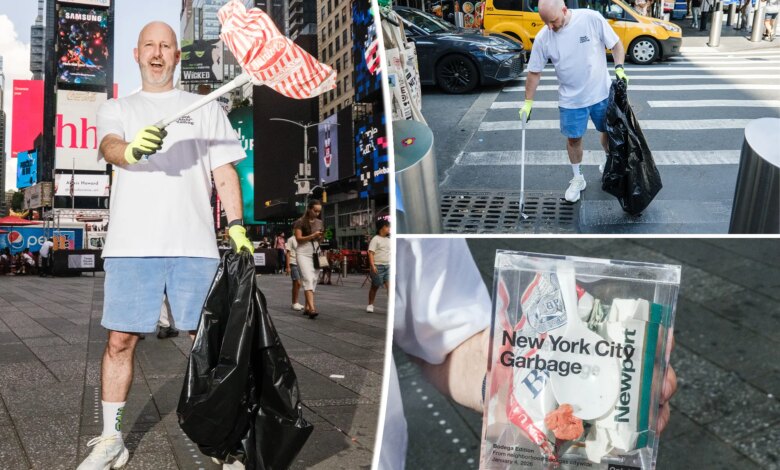
Justin Gignac has spent more than two decades collecting trash off the streets of the Big Apple, packaging it in small, clear cubes and selling them for up to $100 a pop.
New York City Garbage — not to be confused with the city’s Sanitation Department — is a long-term art project that Gignac says chronicles and captures “an actual piece of the city.”
“In New York, we’re famous for our garbage. It’s like a living character of the city. And I think being a bit notorious for being a filthy city really helps,” the artist, 46, told The Post.
“The brand of New York City here is a really big one. Instead of shying away from maybe what would be looked down upon — that we have so much trash everywhere — we embrace that. It’s just a part of being in New York.”
Gignac, of Forest Hills, recently enjoyed a moment of virality for plucking rubbish from outside Taylor Swift’s Madison Square Garden wedding — including a discarded ovulation test kit.
But the sold-out “Not Invited Edition (Taylor & Travis’ Wedding)” trash drop is just the latest in dozens Gignac has released since he first started collecting garbage back in 2001.
The gig started out as a gag — one designed to spite an old marketing co-worker who claimed package design wasn’t important, a declaration Gignac called “crazy.”
The budding trash man snagged a Heineken can, slices of caution tape and bits of newspaper off the streets of Times Square, shoved it into a clear cube and slapped the date on it — and successfully sold it to a stranger.
The cubes have evolved over the years to focus on composition — like one cube in which a Sonny Angel gingerly dangled on the rim of a Greek coffee cup.
Gignac has also pivoted on “drops” throughout the years that capture moments in time, like Swift’s wedding or the 2026 World Cup tournament or back in 2011 when same-sex marriage was legalized in the Big Apple.
“I went down to the city clerk’s office and it was a huge celebration. I found beads and confetti and ring boxes. That felt very of that moment in time. What we throw away is the direct reflection of who we are and what’s happening,” Gignac reflected.
He’s turning the trash into real gold — Gignac has raked in at least $100,000 over the past two decades after selling more than 1,700 cubes at varying price points.
But the mission has largely remained the same — the artist, armed with a garbage picker and gloves, scours different neighborhoods across the five boroughs for interesting trash until he fills up his 40-pound bag.
“I am always looking for things that are either quintessentially New York, like the Greek coffee cup, parking tickets, metro cards. Those things are just very iconic New York pieces of trash,” Gignac explains.
“I love finding things that come from people and have a story behind them, so I love finding photographs, I love finding birthday cards and love notes. I found one [love note] that was ripped in half!”
The only things Gignac won’t pick up are wet trash or anything that might be harboring rats, he admits.
The artist’s dream is to one day have a gallery show at the Museum of Modern Art in which the garbage will be laid out on a map of the five boroughs similar to the iconic Panorama at the Queens Museum.
“Every major neighborhood and landmark will be represented with garbage so people can walk through and compare and contrast and just see, even from neighborhood to neighborhood, how different the garbage is,” said Gignac.
“Garbage is collectible, and I like capturing these moments in time that were a part of history.”