Thune says Republicans can hold their majority — if they stop fighting each other

(Searchlight South Dakota) SIOUX FALLS — U.S. Senate Majority Leader John Thune’s Republican Party faces midterm elections amid economic anxiety, high gas prices and a war with Iran.
But Thune, of South Dakota, said the biggest threat to the party’s Senate majority might be Republicans themselves.
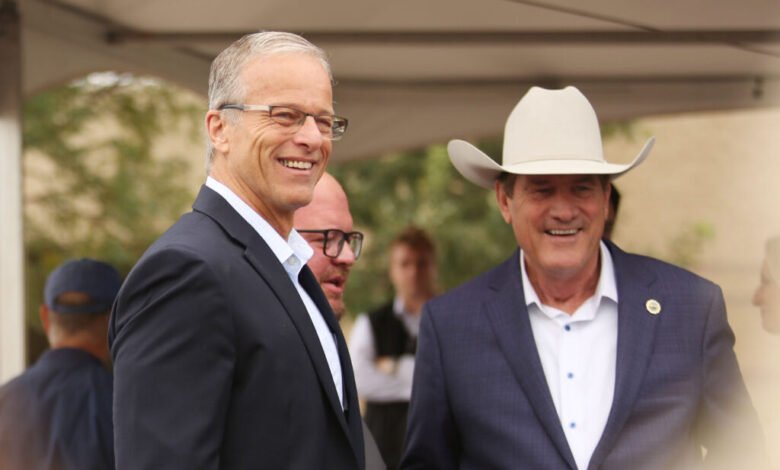
Thune told South Dakota Searchlight and other journalists Friday during an event at Southeast Technical College that Republicans need to “turn our fire on Democrats, not on each other.”
Thune has been under fire from Republican President Donald Trump for not eliminating the filibuster, the Senate rule that requires the votes of at least 60 senators to end debate. Trump has repeatedly demanded the termination of the filibuster to help pass his SAVE America Act, which would require proof of U.S. citizenship when registering to vote and a photo ID when casting a ballot.
Republicans hold 53 of the seats in the Senate, and there are 33 seats up for election on Nov. 3. Thune doesn’t face reelection until 2028.
The following question-and-answer session between Thune and several reporters has been edited for length and clarity.
Q: How much is the war with Iran making your job harder?
It’s complicated on a lot of levels and certainly going into an election year with the politics around that. If you look at the things that have been achieved, there have been some great accomplishments there, but ultimately the way people are going to judge this is: How is it affecting the economy, how is it affecting gas prices, is the Strait of Hormuz open?
I think that’s got to be the singular, clear-eyed focus of the White House administration right now — ensuring that we get the shipping lanes open and get the fuel moving again and ensure that our economy here in the U.S. is not suffering as a result of this.
Q: Do you get the sense there’ll be an improvement before the midterms?
I hope so. I think they continue to, or they are trending toward a deal on that to get the strait open. But these are really complicated issues and you’re dealing with a regime that’s dishonest and is not going to play by the rules that the rest of the world community plays by, so you’ve got to be tough. I think the president has leaned into this in ways that puts a lot of pressure on the regime, but the regime is not going to go quietly. I think there are challenges ahead, but I also feel like they’re on a path toward landing something that will at least get things moving again and hopefully lessen some of the pressure on fuel prices here.
Q: Can the Republican Party maintain its majority in the midterm elections?
I think the headwinds that are there, can it improve? It can. Can it get worse? Maybe. We’re facing typical midterm election political headwinds and some economic headwinds, because people are concerned about the economy and costs and everything else, which they should be since those are pocketbook issues. That’s what most elections are really about.
I still think in spite of those headwinds, we’ve got really good candidates in the right places at the right time. You look at a state like Michigan, things really broke our way. Minnesota broke our way. The Democrats in both places nominated far-left candidates. We have candidates who are really, really accomplished people with a message I think is really going to resonate with voters in those states. Those are hard states, but we need to be on offense in a few places and we are in Michigan, as we’ll be in Minnesota, New Hampshire, Georgia.
We’re defending some ground too and the places where we’re defending there’s a firewall that if we don’t keep certain states, we’ll lose control of the Senate: Maine, Ohio, Iowa, Alaska — that’s the firewall of the Senate.
If we could win one of those races around the country, that obviously would be a huge success too, but it’s a tough year. These midterms always are. This one’s obviously complicated by some factors that we simply don’t control, but we’re doing everything we can within our control: recruiting a good crop of candidates, raising the resources that are necessary for them to get their messages out, and hopefully succeeding in the ground game, which is the “get out the vote” thing that you have to do come Election Day if you’re going to win elections. That’s harder, especially for low propensity voters who typically don’t vote in a non-presidential year. We’ve got to get a lot of those Trump voters out, so there’s a real effort being made.
Q: Can you speak to your evolving relationship with President Trump and about him declining to say whether he supports you continuing as Senate majority leader because of your decisions in that role, including retaining the filibuster?
I take all of that with a grain of salt. There is a natural dynamic between any White House and the Senate. Most presidents, in my experience, don’t like the Senate and view it as an obstacle to getting the things they want to get done. But we obviously have a different way of doing things by design, which makes it harder sometimes. The House in a lot of ways is an extension of the White House. It’s a majoritarian body, while the Senate is a non-majoritarian body. It’s designed to give a voice to the minority in this country, so it’s harder to get things done because most things require a supermajority.
Those are the facts I have to live with, and I have very honest conversations with the president. He is entitled to his views about the things that we’re doing in the Senate. I would certainly expect that he has a way of doing things. He’s got a business model that’s full speed ahead, and I know that sometimes in the Senate, just by virtue of the reality on the ground that we have to deal with, we have to pump the brakes occasionally on that. And that’s not something that obviously he probably is good with, but nevertheless we get a lot done and if you look at the record of accomplishment, I think it’s second to none.
Updates from our D.C. Bureau, delivered: Sign up for our free newsletter.
We can’t get everything done because it’s a function of votes. I tell people that the math is the math, and the math on the issue that he cares the most about right now isn’t going to change, at least not until after the election. Then we’ll see from there. We get along fine and work together, but if he wants somebody else in the job he’s welcome to that view.
Q: Do you worry that President Trump’s critical view of the body and fellow Republicans right now will be a hindrance ahead of the midterms?
What I’ve said, and I make this point quite regularly, is that we are less than 90 days away from an election. The election ought to be painting a contrast between us and the Democrats and not creating conflicts with fellow Republicans.
I’ve tried to deliver that message in the work that we’re doing right now, the work we’re focused on keeping, protecting and preserving our majority in the Senate — maybe even expanding it if we could get a win in a state or two. But I am a clear-eyed realist about what we have to do, what’s in front of us and the best way for us to be successful, which is to have everybody pull in the same direction and turn our fire on Democrats, not on each other.
That’s a message I deliver regularly and it seems to be getting across at least on some level, but I think it’s in everybody’s best interest — if you want to have a Republican Senate majority after the election — is not to have us turning fire on each other, but drawing contrasts with Democrats, and there are plenty to draw.
If you want to have a debate about the future of this country, you can really do it because there is a clear division in my view between the two visions of where the parties are headed and where the candidates are headed. I mean, look at Michigan and Minnesota, look at some of these states where you’ve got these far-left, radical Democrats winning elections or winning primaries at least. I think that represents a great opportunity to contrast with them in the fall, and that’s where we ought to be focused.