There is no denying that Denny Sanford has transformed South Dakota with his checkbook.
His donations have reshaped skylines, funded health care expansion, and saved taxpayers tens of millions of dollars. In Sioux Falls alone, his name crowns the Denny Sanford Premier Center and the Denny Sanford Sports Complex off I-29— projects that would have required significant public funding without his contributions.
Across the state, his philanthropy stretches west to the Sanford Black Hills Medical Center and the Sanford Underground Research Facility in the Black Hills. His generosity toward Sanford Health has undeniably strengthened the region’s medical infrastructure.
And now, with a $50 million donation to relocate the Smithfield plant and redevelop the land near Falls Park into what will be called the “Sanford District,” his imprint deepens yet again.
For taxpayers, the math is simple: private dollars spared public ones. In a state that prides itself on fiscal conservatism, that matters.
But civic gratitude does not erase civic questions.
As Sanford’s name spreads across buildings, districts, and institutions, so too does the legacy of how that fortune was made. Much of Sanford’s wealth came from mastering the subprime credit card industry, operating under South Dakota’s permissive usury laws that allowed high interest rates. It was legal. Entirely legal. But legality and legacy are not always the same thing.
The subprime credit market disproportionately serves the financially vulnerable — the poor, the working class, and often the elderly. Critics argue that profits in that space are built on compounding hardship. Supporters counter that credit access, even at high rates, provides opportunity where none might otherwise exist.
Both arguments exist. Both deserve acknowledgment.
What is undeniable is this: South Dakota, and particularly Sioux Falls, is increasingly defined by one name. A name that now marks our arenas, our medical centers, our research facilities — and soon, a major redevelopment district near the city’s most iconic natural landmark. And remember Sanford said he never wanted his name of image anywhere?!
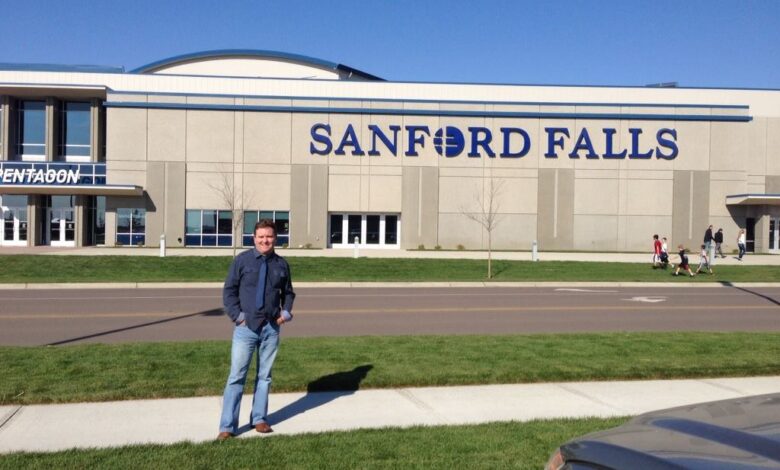
Once, it was simply Sioux Falls. Increasingly, some half-jokingly call it “Sanford Falls.”
Philanthropy can be transformative. It can also be branding. In South Dakota, the two are now inseparable.
Taxpayers have saved millions. Our infrastructure has grown. Our health systems have expanded.
But as the Sanford name becomes permanent across our public landscape, so too does the debate over what that name represents — generosity, opportunity, controversy, or some complicated mix of all three.
That is the true cost of naming rights: not just dollars, but legacy.