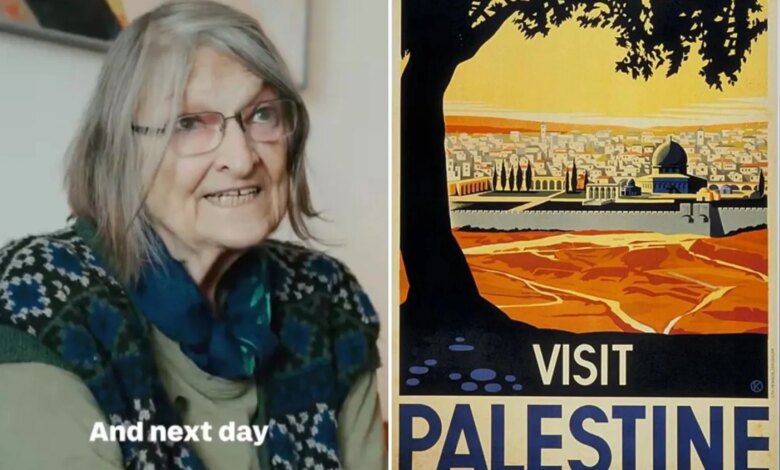
Like all theater kids, the artist formerly known as Young Cardamom — more famous now as Zohran Mamdani — loves a good prop.
So when his administration released a tear-jerker of a video to commemorate the Nakba, the word Palestinians use to describe their displacement during the war of 1948, it began with a tracking shot of a gorgeous poster hanging in the home of 88-year-old Inea Bushnaq.
The poster shows the Old City of Jerusalem in the shadow of a lonesome olive tree, with a caption that read “Visit Palestine.”
The camera caresses it longingly, as Bushnaq shares her sob story of having to flee the dastardly Zionists who kicked her out of her home all those decades ago.
Never mind that Bushnaq’s story ignores the complexities of a war started by five Arab armies, which invaded the nascent state of Israel amid vows to eradicate it.
Never mind that the term “Nakba” itself, literally meaning “disaster,” was coined by a Syrian professor who used it to describe not the Jews’ attempt at self-defense, but the sheer and gross stupidity of virtually all Arab states in waging war against Israel — and then losing badly, despite overwhelming numeric advantages.
And never mind, too, that Bushnaq herself is far from the indigenous daughter she claims to be: Her grandparents left their native Bosnia and settled in Syria before finding their way to Jerusalem, making them — to borrow a phrase Mamdani voters use often to describe the Jewish citizens of Israel — European colonizers.
What’s truly mind-blowing about Mamdani’s video is the fact that it lingers long enough on that poster to reveal the name of its creator, one Franz Kraus.
If that name doesn’t sound particularly Palestinian to you, it’s because Kraus was an Austrian Jewish artist forced to flee the Nazis.
Like many Jews lucky enough to escape Europe in time, he moved to the ancestral homeland of the Jewish people, then still known by its ancient Roman name, Palestine.
The artwork he created perfectly expressed his longing for the city of Jerusalem — the capital of the Jewish people since at least 1003 BCE, two millennia before the Bushnaqs moseyed over and declared the place their own.
As you can clearly see in Mamdani’s video, Kraus signed his name on his artwork. In Hebrew.
Now, look: the mayor has every right to put aside trivial matters of no concern to New Yorkers, like the surge of murders and robberies on the subway, and focus instead on what he sees as really important — a complicated century-old conflict on the other side of the world.
He may also be forgiven for blatantly taking sides, tossing aside all his empty promises to Jewish New Yorkers and releasing his hateful video just before sundown on Friday, all but guaranteeing that observant Jews would not be able to see it or respond for at least 25 hours.
But when the mayor produces work so clownishly amateurish that it argues for fake Palestinian refugees by showcasing the work of real Jewish ones — well, that, frankly, is an insult.
All of us living in this city have known, and loved, our share of con men.
We’re far from averse to slick talkers telling tall tales.
But when the hoax the mayor chooses to promote is a bit of third-world propaganda, and when he packages it so poorly that it not only shamelessly lies about history but doesn’t even bother to cover up the fabrication, we’ve no choice but to respond with that time-worn New York credo: Get outta here.
Incompetent mayors we may forgive.
Fiery ideologues who care more about their partisan, hateful narratives are, sadly, nothing new.
But Mamdani’s combination of malice and ineptitude is a new and not-at-all-welcome phenomenon, to Jews and all New Yorkers alike.
Liel Leibovitz is editor at large for Tablet and senior fellow at the Hudson Institute.