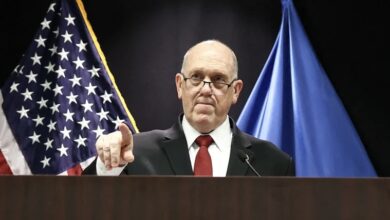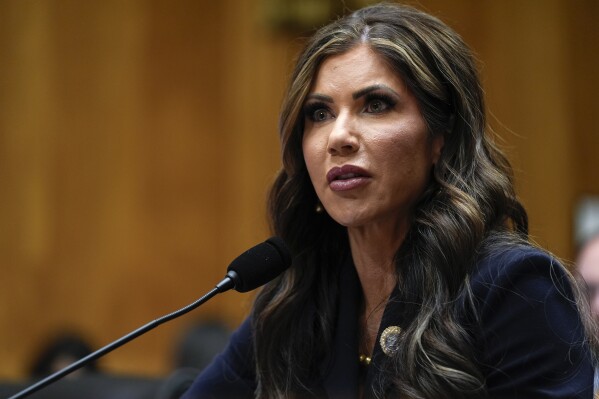
A federal judge has ordered two Justice Department officials to testify in a case examining whether Homeland Security Secretary Kristi Noem should face criminal charges for allegedly violating a March 2025 order halting the removal of Venezuelan migrants.
The Trump administration used the Alien Enemies Act to proceed with deportation flights despite that directive, prompting scrutiny of former DOJ attorney Erez Reuveni, who alleges officials discussed ignoring court orders, and Deputy Assistant Attorney General Drew Ensign, who reportedly conveyed the judge’s instructions.
The decision marks the latest development in a long-running legal clash over the government’s use of a rarely deployed wartime statute and the subsequent handling of migrant flights to El Salvador.
Why It Matters
At the center of the escalating court fight is a fundamental test of presidential power and judicial authority: whether the Trump administration can invoke a centuries-old wartime statute to summarily deport Venezuelan migrants—and whether Homeland Security Secretary Kristi Noem defied a federal judge’s order to stop those removals.
The outcome will determine not only the legality of using the Alien Enemies Act for immigration enforcement but also the limits of due-process protections for people on U.S. soil and the courts’ ability to enforce their directives in real time.
The underlying litigation stems from a class-action complaint filed in March 2025 on behalf of Venezuelan detainees who argued that the administration’s planned removals were unlawful under the Alien Enemies Act, the Immigration and Nationality Act, and constitutional due-process protections.
The filing alleged that the administration intended to use a forthcoming presidential proclamation to authorize “immediate” removals without judicial review, relying on a theory that the Venezuelan gang Tren de Aragua constituted a “foreign nation or government” engaged in an “invasion or predatory incursion.”
U.S. District Chief Judge James E. Boasberg issued a temporary restraining order the evening of March 15, 2025, barring the removal of the named plaintiffs for 14 days.
Disputed Flights and the Court’s Growing Concerns
Later filings revealed that two planes carrying Venezuelan detainees nevertheless landed in El Salvador.
The court subsequently initiated inquiries into whether that outcome violated its directive.
In a December 8, 2025 order, Judge Boasberg wrote that Secretary Noem had submitted a declaration stating she made “the decision to continue the transfer of custody of the Alien Enemies Act detainees who had been removed from the United States before this Court issued its temporary restraining order in the evening of March 15, 2025.”
To establish a fuller factual record, Boasberg ordered that plaintiffs “attempt to secure the presence of Erez Reuveni for testimony on December 15, 2025,” and required the government to “produce Drew Ensign for testimony on December 16, 2025.”
The judge found the declaration insufficient to determine whether Noem’s decision constituted a willful violation.
Because criminal contempt requires a showing that the order was “clear and reasonably specific,” that “the defendant violated the order,” and that “the violation was willful,” he wrote that “the Court cannot at this juncture find probable cause that her actions constituted criminal contempt.”
Testimony That Could Define the Court’s Contempt Ruling
Reuveni is a former Justice Department attorney who has filed a whistleblower complaint alleging internal discussions about possibly disregarding judicial orders—allegations the administration denies.
Ensign, a Deputy Assistant Attorney General, previously helped convey Boasberg’s oral and written orders to the Department of Homeland Security.
Boasberg described Noem’s filing as “too ‘cursory’ to establish probable cause for criminal contempt” and stated that further witness examination is necessary “to clarify the decision-making around the flights to El Salvador before determining whether a contempt referral is warranted.”
Government attorneys have previously argued that the planes in question had already departed U.S. airspace before the restraining order was signed and that the migrants aboard them had therefore already been “removed.”
As a result, they contend, the flights did not violate the order’s prohibition on removing “any of the individual Plaintiffs from the United States for 14 days.”
The contempt inquiry runs parallel to the broader litigation over the legality of the Alien Enemies Act proclamation.
The complaint asserts that the Act can be invoked only during a declared war or an invasion by a foreign nation and argues that the administration’s application—focused on a transnational criminal group—was ultra vires [someone in power did something they had no legal authority to do].
That group was Tren de Aragua, a Venezuelan-origin criminal organization that the administration attempted to treat as if it were a foreign government for purposes of invoking the Alien Enemies Act.
It further contends that the expedited removal process denied asylum rights, statutory protections under the Convention Against Torture, and due-process guarantees.
Judge Boasberg’s upcoming hearings are expected to clarify the administration’s internal communications and decision-making in the hours surrounding the restraining order.
Only after hearing from Reuveni and Ensign, he wrote, will the court determine whether the circumstances warrant a criminal contempt referral.
As the case proceeds, it continues to test the limits of executive immigration authority, the reach of wartime statutes, and the ability of federal courts to enforce emergency orders during fast-moving enforcement actions.
What People Are Saying
Kristi Noem on what should happen to the deported migrants in CECOT, said: “We’re confident that people imprisoned there should be there…They should stay there for the rest of their lives.”
Emil Bove, DOJ, as quoted by whistleblower Erez Reuveni, allegedly told DOJ lawyers that “the planes need to take off no matter what.”
What Happens Next
The court will now hear testimony from former DOJ lawyer Erez Reuveni and Deputy Assistant Attorney General Drew Ensign so Judge James Boasberg can determine whether Homeland Security Secretary Kristi Noem willfully violated his March 15 order halting migrant removals.
Only after evaluating their accounts and the surrounding decision-making will he decide whether a criminal-contempt referral is warranted, while the broader lawsuit challenging the administration’s use of the Alien Enemies Act continues on a separate track and may prompt additional injunctions or disclosures as the court works to prevent further removals during the litigation.