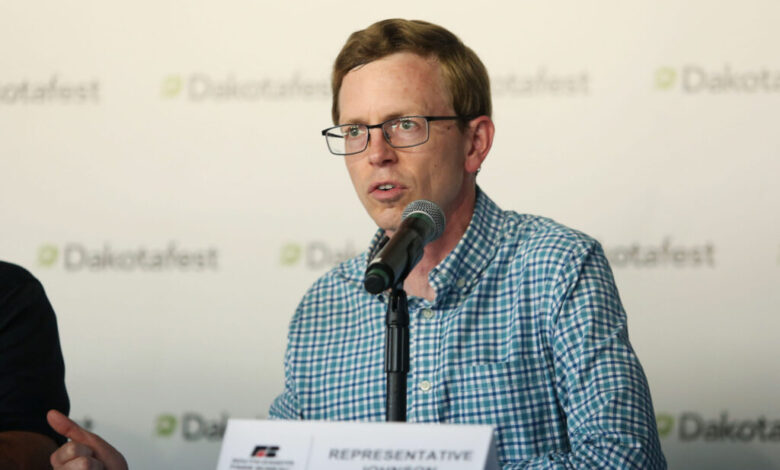
(South Dakota Searchlight) Republican U.S. Rep. Dusty Johnson said Thursday he does not know what’s next for him after his failed bid for South Dakota governor, and while he’s helping one of the remaining Republican candidates, he does not plan to make a public endorsement unless he’s asked.
South Dakota Searchlight sat down with Johnson for an interview in Sioux Falls. He did not say which of the remaining candidates he’s assisting.
Johnson said his campaign was affected by a political environment hostile to candidates with experience in Congress.
“It’s not a good time to be connected to Washington, D.C.,” Johnson said.
He finished third in the four-way June 2 Republican primary behind Aberdeen businessman Toby Doeden and Gov. Larry Rhoden, who will face each other in a July 28 runoff election. Johnson finished ahead of state House Speaker Jon Hansen. The spread between first and last place was 10 percentage points.
Johnson will remain a U.S. representative until January. He has no specific plan for his future after that, other than remaining in Mitchell, where his wife has a business and one of their three sons is still in high school.
He did not rule out a return to politics, but said his “heart isn’t set on that,” adding that his motivation has always been “to do something” rather than “to be something.”
“It’s about the impact,” he said.
The following interview has been edited for length and clarity.
-What happened?
Well, it’s not a good time to be connected to Washington, D.C. Nine of my congressional colleagues have lost in the last year. When running for higher office, that’s an unusual number.
It used to be thought that being in the U.S. House was a good place to run for the Senate or for governor from. That’s really not the case anymore. Clearly, there’s a lot of dysfunction in D.C., and particularly if you are a more Reagan-minded Republican, a more establishment-viewed Republican, that can be hard to overcome in a primary.
And I’d note, we were ahead the whole race — three weeks out, four weeks out, we were 16 points up.
It was really the negative ads calling me a “RINO” [Republican in Name Only] or a liberal that, in those last two weeks, just cratered our numbers. And we saw that in our polling. People were increasingly saying, when we were asking them why they were voting for somebody else, “Well, you know, Dusty’s a liberal. Dusty’s a RINO.” And we probably did not do a good enough job of combating those negative ads. They really, really worked.
-Why didn’t you target Doeden for criticism during the campaign?
Early on, particularly, it showed that there wasn’t a lot of overlap between Doeden voters and Johnson voters. If people were thinking about voting for me, they were also thinking about voting for Larry.
Now, that changed as the campaign went on. And indeed, as the negative ads against me in the last two weeks worked and took 10 points off our number, overwhelmingly, those people moved to Doeden. And that would have been fine if we would have made the runoff, but we fell just a couple thousand votes short of making the runoff.
I would have felt great about our chances against Toby in the runoff. But in the end, that’s not what happened.
-Do you regret the votes you took in Congress that your opponents alleged were out of step with President Trump?
Number one, to the extent that they were principled votes, I don’t think you can ever regret your principles, right?
I mean, voting to certify the 2020 election was what the Constitution, the plain and clear reading of the Constitution, demanded of me. And so my political life might have been a little easier if I would have ignored the Constitution, but I’m just not capable of doing that.
The interesting thing is the attacks that had the most negative effect on me weren’t even the votes where I deviated from the party norms.
I mean, one attack that was really effective was saying Dusty Johnson voted with Ilhan Omar — that’s a liberal congresswoman from Minnesota — to defund ICE. It took us the longest time to figure out what they even meant by that. And that was an attack that Larry and Toby were making.
Near as I can tell, I voted against a Joe Biden spending package. I thought the Joe Biden spending package was too liberal. I voted against it. They’re, as a result, alleging that I voted to defund ICE. Ilhan Omar voted against that package because it wasn’t liberal enough for her.
I voted with the overwhelming majority of Republicans and all conservatives, but that clearly conservative vote was still distorted, and I’m not complaining about it. I mean, I think we all know that goes on in politics. I have no bitterness. I don’t have any regret.
U.S. Rep. and candidate for governor Dusty Johnson addresses supporters at his primary election night watch party in downtown Sioux Falls on June 2, 2026. (Photo by Makenzie Huber/South Dakota Searchlight)
U.S. Rep. and candidate for governor Dusty Johnson addresses supporters at his primary election night watch party in downtown Sioux Falls on June 2, 2026. (Photo by Makenzie Huber/South Dakota Searchlight)
I mean, at some point, we know that these primaries are going to be hard-fought. I’m not a sore loser. Toby and Larry won, and I didn’t.
And I think one of the reasons that I can handle the loss so well is that my motivator has never been to be something. It’s always been to do something. And we still have an opportunity to work together to improve South Dakota education, improve South Dakota public safety.
I don’t have to be governor for our state to make great things happen. And we deserve a great state. We deserve a great governor. And I’m committed to those things even if I’m not going to be the guy.
Rhoden and Hansen supported new laws that fund homeowner property tax reductions with higher sales taxes. Your campaign messaging criticized them for the sales tax increases. Was that not effective? What was the feedback?
That messaging was fantastically effective.
I mean, the campaign started with Larry and Dusty in a statistical tie at 29%. And once people understood more about the three sales tax increases, Larry went down to 23. We went up to 33. And Larry never fully recovered from that. Rather, I think he finished at 25.
And so the idea that the sales tax increases weren’t an effective differentiator isn’t supported by the data.
And indeed, I think that was part of what caused Toby’s run-up — the outside advertising, particularly. It was far harsher on Larry and John than anything we had designed or approved.
[The sales tax messaging] put a lid on Larry and John’s support. They just couldn’t get above 23 or 25 points. And when the negative ads calling me a liberal took 10 points off me, those voters couldn’t really go to Larry and John because they didn’t trust them on taxes. And so they were willing to go to Toby, who they viewed as a guy talking about big vision in the same way that our campaign was talking about big vision.
I don’t think that necessarily means that Toby Doeden’s going to be a great governor. I just think the voters in a multi-candidate field were having to figure out who they could vote for, as they were learning things about the other candidates they didn’t like.
-Who will you vote for in the runoff?
Well, there has been a bit of a controversy this campaign season about people being endorsed by folks they didn’t want to be endorsed by. And so no candidate has asked me to publicly endorse them.
I’ve had multiple conversations with both Toby and Larry. When they’ve asked, I provided them my honest feedback.
One of the campaigns has asked me to help in some other ways, and I’m doing that. But I’m not going to announce that publicly unless they ask. I think it would be unfair to them.
Again, I called and reached out to both Toby and Larry and congratulated them because, again, they’re winners and I don’t have any intention of being a sore loser.
Listen, this is politics. We’ve all won in life, and we’ve all lost. Winning beats the heck out of losing, but I still know South Dakota has got great opportunities in the future.
You and your team worked hard, including using money from your political action committees, to get legislators elected that align with your agenda. That happened, but you lost. Isn’t that ironic? How does that happen?
Because the Republican primary electorate is hardwired to view attacks like “career politician” and “RINO” as radioactive. And although we certainly talked a lot about, I think, the unfortunate tax increases that John and Larry put into place, we were trying to make an argument about policy, right?
My differences with them were policy. Those were very different than the insults that the other candidates leveled at me, and just honestly, their negative ads were more effective than anything the outside groups were running on my behalf.
But no, I don’t think there’s any irony that Larry and Toby will have a more functional Legislature because of my hard work. I want South Dakota to have a good Legislature, regardless of who was governor.
I’m not interested in a functional South Dakota only if Dusty Johnson’s governor — I love the state, regardless.
Is there room for bipartisan “workhorses,” rather than “show horses,” in today’s Republican Party?
Certainly, election results from the last year have shown that it is really hard to get elected if you focus on common ground building.
Again, nine of my colleagues in the House have lost their runs for higher office just in the last year. And that’s much higher than has historically been normal.
But I still think honest people, principled people, are still going to do the right thing, even if maybe the political marketplace doesn’t reward them for it.
Did you seek President Trump’s endorsement? Would it have made a difference?
I think we’ve seen, like in Iowa with Randy Feenstra — also a very hard-working, policy-focused member of the House, a close ally of mine — he received the Trump endorsement and lost his governor’s race.
And I think it just goes to show that even with the Trump endorsement, if you’re viewed as somebody who’s more interested in working together than fighting, the race is going to be a little different. And we knew that going in.
Within the “America First” movement, we’re now seeing more influential figures like Tucker Carlson and Candace Owens break with President Trump. What do you think is going to come of the Republican Party?
It does seem like both parties are being led by ever angrier and louder voices. That is not going to make for good outcomes in this country. But the fever will break.
I mean, we have been here before.
You look at the turn of the last century where you couldn’t find a newspaper that wasn’t a party organ.
I mean, it was the Mitchell Daily Republican — that was the name of the paper, literally. Hundreds of papers had partisan names and thousands of them were party organs, even if not by title.
Listen, this is politics. We’ve all won in life, and we’ve all lost. Winning beats the heck out of losing, but I still know South Dakota has got great opportunities in the future.
And frankly, Americans had segregated themselves into ethnic and ideological ghettos — very, very tribal. And then something happened, the fever broke, and Americans decided to have more of a common identity. And they sought out platforms that were more interested in facts than in spin.
And I think the yellow journalism of the early 1900s was every bit as dangerous as the yellow journalism of today’s cable news. I think they’re both toxic to the healthy functioning of a free society.
But the fever broke then, and the fever will break now.
The good book says that the day of the Lord comes like a thief in the night. And I don’t know when that happens, but I’m a believer in American exceptionalism. I don’t think these things happen by accident. I don’t think this is just another country.
I think if good people continue to stay engaged, the fever will break, and we’re going to get back to the kind of country that my kids deserve.
-Do you regret any of your positioning in regard to President Trump, either being too aligned or not enough?
Well, I supported President Trump when I thought he was right.
There were certainly disagreements he and I had on things like invading Greenland, the Qatari jet, and certifying the 2020 election. But, I mean, at some point, if you’re not going to be authentic to your views, then why run, why serve?
Certainly, the president and I agreed far more than we disagreed. And we never had any particular problem. I mean, he knew that I had different views on trade, that we have different views on NATO and on the role of free trade agreements and security agreements. That never bothered him.
This was a guy who invited me to Mar-a-Lago. He had me over to the Oval Office. We had lots of productive meetings because we were both focused on getting things done. And no two people agree on everything.
I think that’s one reason that he was reluctant to endorse an incumbent governor in this race. And it is unusual that he did not endorse an incumbent governor, and I think part of that is because he and I had such a good working relationship.
-What do you plan to do next?
I don’t have any idea. I love this state. My wife’s business is in Mitchell. We’ve got a 14-year-old in Mitchell schools, and our oldest is at South Dakota State University. Our middle child’s at the University of South Dakota. And so South Dakota’s home.
I want to lead a life of consequence. I want to have an impact. I want to do things to improve this state.
Of course, you can do that in the private sector. You can do that in business. You can do that in nonprofit. You can do that in government.
I don’t have any idea what’s next, but I know leaders eat last, and we’ve got a lot of really talented professionals who are on the campaign, who love this state, and they want to find a job here, and I’m working hard to make sure that they can find a job.
And then we’ve got an incredibly talented and committed team on the official side, who work for the United States House, our office. They’ll have jobs through the end of the year, but they are so talented that, I mean, I’ll feel duty-bound to try to make sure that some great enterprise is able to hire them so that they can keep making the state great.
-Does Dusty Johnson have a political future?
Oh, it’s so hard to say.
I think two weeks after an election is the wrong time for me to decide. We don’t even have all our highway signs down yet. And so I don’t know what the future holds.
Certainly, there are many examples of successful elected officials, such as John Thune and Bill Janklow, coming back after a loss. But my heart isn’t set on that.
Again, I’m more focused on doing things rather than being things. It’s about the impact. And so I don’t know.
If you told me that in my 70s, I was on the school board or in the state Legislature, I wouldn’t be shocked at all.