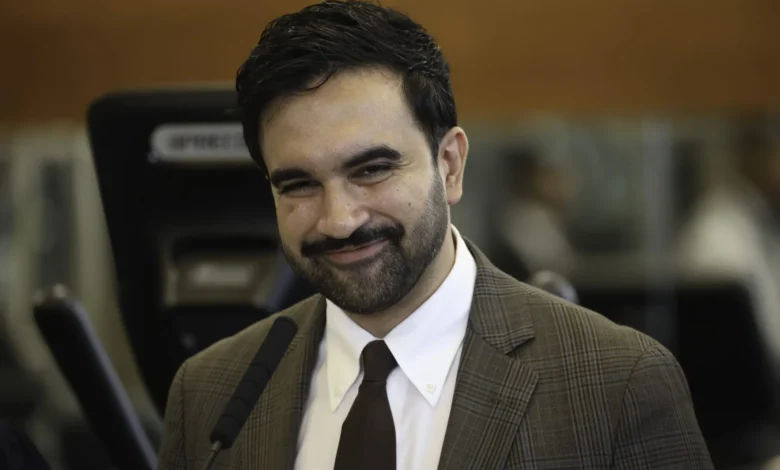
Mayor Zohran Mamdani campaigned on cleaning up the Department of Education’s bloated contracting — promising to audit its biggest vendors and root out deals built on who you know instead of what you do.
So, it’s odd that four months after the City Council asked to see DOE’s contracts, it still hasn’t gotten them all.
This month, Speaker Julie Menin threatened subpoenas over the hundreds of missing contracts.
Mamdani says the council will have them “in the coming weeks.”
For a mayor who ran on following the money, it’s a strange thing to slow-walk.
Much of the school system runs on outside vendors. The DOE spends nearly $13 billion a year contracting out busing, cleaning, food, technology and special-education services.
It buys the same services year after year. When a contract expires, the city can rebid it or renew with the same vendor. It usually renews.
The problem is the billions of taxpayer dollars flowing through decades-old contracts that get renewed, extended and expanded without ever being tested against a competitor.
Last year, only about 13% of the DOE’s newly registered contract dollars were competitively awarded; 57% of that — about $1.06 billion of $1.87 billion — consisted of renewals or other awards whose terms had already been established under earlier contracts.
These deals are perfectly legal. And that is exactly the problem.
The city reviews whether contracts meet legal and procedural requirements — not whether another vendor can provide the same or better service for less.
Unlike nearly every other city agency, the DOE doesn’t have to follow the Procurement Policy Board rules — the citywide standards that promote competition and help ensure taxpayers get the best value.
State law exempts it.
Contracts over $1 million still go before the Panel for Educational Policy, and the comptroller registers them.
But none of those steps asks whether another vendor could deliver the same or better services at a lower cost.
The school-bus system is the clearest example.
After labor protections adopted following the 1979 bus strike made rebidding politically difficult, the city repeatedly extended contracts with the same companies.
In 2013, after the state’s highest court ruled contract protections could not be required in new competitively bid deals, the Bloomberg administration rebid school-bus routes for the first time in more than three decades.
Drivers struck for a month, disrupting transportation for more than 100,000 students.
Then Mayor Bill de Blasio undid it –– canceling the next round of bids, spending $42 million to subsidize winning companies’ wages and returning to the practice of extending contracts.
The routes haven’t faced a real bid since. Last November, the Adams administration extended the contracts again.
In more than 40 years, the city’s school-bus contracts have faced real competition only once.
The custodial system followed a similar path.
In 2016, rather than competitively rebidding custodial services, the de Blasio administration created NYC School Support Services, a DOE-affiliated nonprofit employing roughly 8,000 workers.
A 2022 state comptroller audit found the DOE awarded the $6.4 billion custodial contract noncompetitively, without meeting its own procurement rules.
Auditors found no detailed cost breakdown, no measurable performance standards and only a five-business-day opportunity for other vendors to respond.
Universal Pre-K was also expanded in the same way.
It launched in 2014 with hundreds of community providers; many are still paid today under contracts that were never rebid.
And school food shows how expensive no-bid gets: A 2021 city comptroller report found that over four years — all under de Blasio — the DOE spent more than half a billion dollars on “approved brand” food products with “no competitive bids or proposals.”
Federal prosecutors charged the DOE’s former food chief and three food executives with felonies. And when the city finally bid out just five of those products, it saved $7.8 million.
Other agencies show that regular competition is both possible and routine.
Environmental Protection competitively awarded 72% of its contract dollars. Sanitation nearly matched it, at 68%. Parks hit 61%; Transportation, 53%.
Yet, the nation’s largest school system? 13%.
That is what the council is trying to expose. And what Mamdani campaigned on fixing.
When the council finally gets the contracts, it should look at not only the no-bid awards but also the ones that haven’t been competed for in years.
But fixing the process falls to City Hall.
As each contract comes up, the city decides: Solicit competitive bids or extend it.
Mamdani’s budget pushed DOE spending to a record $38.6 billion — nearly $4 billion more than last year.
But his plan banks on procurement savings.
Those savings materialize only if the city makes vendors compete.
Mamdani campaigned on reform. Now comes the test.
Jennifer Weber is a fellow at the Manhattan Institute.