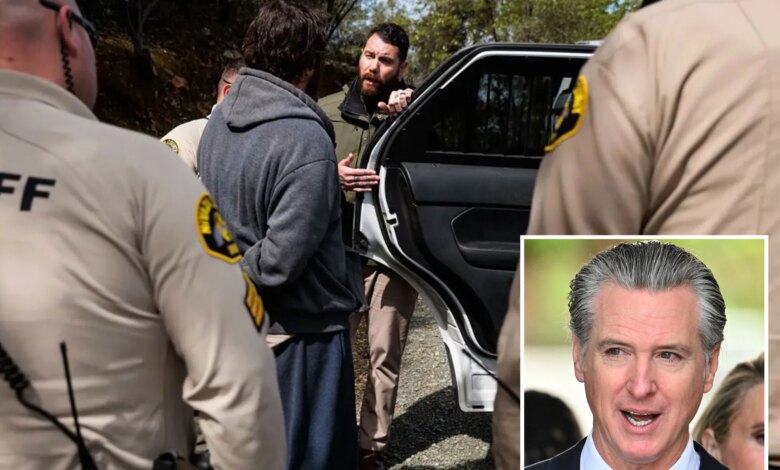
California Gov. Gavin Newsom has finally signed legislation cracking down on the “Epstein loophole” that critics said allowed convicted child abusers and other serious offenders to avoid prison through the state’s mental health diversion program.
As part of a broader package of legislation and budget measures signed last week, Newsom narrowed the state’s law, which has been in effect since 2018.
Under the original law, judges were generally required to grant diversion to eligible defendants if a qualifying mental illness significantly contributed to the crime and the defendant was not deemed an unreasonable risk to public safety.
Those accepted into diversion programs could avoid jail time by completing court-approved mental health treatment. Under the new law, diversion is no longer presumed for eligible defendants.
Instead, judges now have full discretion to determine whether placing someone in community-based treatment would endanger public safety, including whether it could increase the likelihood of physical injury or other serious harm to others.
“California believes treatment and accountability go hand in hand. We are proud to preserve mental health diversion for people who can benefit from it while ensuring judges have the discretion they need to protect victims, safeguard communities, and make decisions based on the full picture before them,” Newsom said in a statement.
The measure received sweeping bipartisan support, with backers arguing the previous law stripped judges of their discretion by forcing them to grant diversion even when they believed it was inappropriate.
“Even if a judge believes diversion is not appropriate, they may still be forced to grant it,” bill author Assemblymember Stephanie Nguyen, an Elk Grove Democrat, said in a statement supporting the legislation. “That’s not justice. It’s not fair to victims, and it’s not fair to communities who expect the courts to keep them safe.”
The push to overhaul the law came after several cases sparked outrage across California.
Among the most prominent was former Kern County Supervisor Zack Scrivner, who was charged in February 2025 with felony child abuse and possession of assault weapons.
Prosecutors also alleged Scrivner climbed into bed with a child while under the influence of drugs and touched the child inappropriately, though he was not charged with child sexual assault.
The case ignited renewed criticism of the diversion law, with opponents branding it the “Epstein loophole” and arguing it had become a get-out-of-jail-free card for dangerous offenders.
The backlash intensified after Scrivner’s son, Robert Scrivner, publicly denounced his father and the law that allowed him to avoid jail.
Speaking at a February press conference hosted by state Sen. Shannon Grove, Robert called California’s mental health diversion law a “flawed system.”
“My own father, who is an elected official in Kern County, assaulted my siblings and myself and was granted mental health diversion,” Robert said.
In response, Grove introduced Senate Bill 1373, which sought to bar people accused of certain violent crimes from qualifying for mental health diversion.
“My bill will ensure that those who commit violent crimes, such as attempted murder of a child, assault resulting in death and domestic violence, are no longer eligible for a mental health diversion program,” Grove said at the time.
Supporters argued the legislation was necessary to restore judicial discretion and ensure serious offenders could not exploit the diversion system.
Opponents, however, warned the changes could limit access to treatment for people whose criminal conduct was driven by mental illness.
The Ella Baker Center for Human Rights, which opposed the measure, argued that “removing the option is a step backward for California, eliminating much-needed flexibility and discretion.”
Critics of the bill also said lawmakers were using a handful of high-profile cases to justify restricting a program that has helped thousands of people avoid jail while receiving treatment.
They further argued diversion programs help address the disproportionate incarceration of people of color by allowing eligible defendants to avoid convictions that can create long-term barriers to housing, education and employment.
Supporters countered that the changes preserve mental health diversion while giving judges greater authority to deny it when public safety is at risk.
Download The California Post App, follow us on social, and subscribe to our newsletters
California Post News: Facebook, Instagram, TikTok, X, YouTube, WhatsApp, LinkedIn
California Post Sports Facebook, Instagram, TikTok, YouTube, X
California Post Opinion
California Post Newsletters: Sign up here!
California Post App: Download here!
Home delivery: Sign up here!
Page Six Hollywood: Sign up here!