During World War II, over 16 million Americans served in the Armed Forces. Today, less than 45,000 are still alive. I spent the past ten years interviewing Marine Corps veterans who fought in the Pacific Theater for my forthcoming book, “The Last of the Old Breed: An Oral History of the Final Marines from World War II” (St. Martin’s Press). Of the 130 survivors I spoke with, the youngest was 90 and the oldest was 103.
And they have a final message for America.
Les Anderson was 95 years old when he sat down for an interview in 2021. He had never discussed the war before our meeting.
“I thought I would be able to talk about it now, but I still have trouble,” he said, tears streaming down his face. “I thought I could forget about it, but that doesn’t work either.”
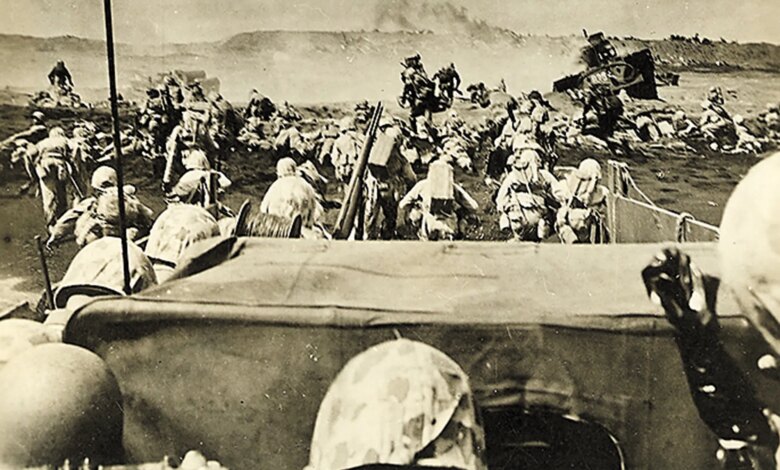
On Feb. 23, 1945, 21-year-old Anderson landed on the black sands of Iwo Jima as a radio operator with the First Provisional Artillery Group. It was the start of a 30-day descent into hell.
From his foxhole at the base of Mount Suribachi, he watched as flamethrower operators sprayed burning fuel into Japanese bunkers. The occupants would race into the open, engulfed in flames.
“It didn’t make any difference whether you rolled in the sand or not: the napalm either killed you or suffocated you,” he said.
“The heat and the flames would suck the air out of the tunnels. Then our bulldozers would come up and push sand over the entrances. That stuff is why I’ve never talked about the war before.”
Anderson, a prototypical silent member of his generation, broke his silence for one reason: to remind Americans of the price of freedom.
“I hope that they’ll remember that freedom is not free,” Anderson said.
“It really disturbs me now with all this bickering. I just don’t understand that. Back in World War II, even the little kids would gather pots and pans. Even when I came back, I was buying E-stamps, which you put in a book to help pay for things. I hate to leave this world in such a mess.”
Les Anderson passed away in 2022 at the age of 98.
Kenneth Brown was also reluctant to speak about his experiences on Iwo Jima. As a young chaplain’s assistant, he spent the first day of the battle aboard a troop ship.
“They were bringing some of the wounded aboard,” he said. “That was the first time I’d seen injured men. Some of them were dying . . . they were in terrible pain because the morphine had worn off. The chaplain and I went down and helped. Some of the men were giving their last words; they knew they were going to die. I took down notes of what they wanted to say, something to send back to their parents. That was my first experience with how hellish war is.”
Later in the battle, Brown would assist in the burial of nearly 7,000 young Americans on the island. One was his best friend, a boy from Plano, Idaho, named Lorin Oakey.
Oakey had been killed on March 2, 1945. He was 22 years old.
After the war, Brown didn’t speak about Iwo Jima for over 50 years. He was plagued by nightmares and flashbacks. It wasn’t until he started lecturing at Ricks College in the 1980s that he realized young people knew very little about what had happened in World War II.
A chance conversation in Rexburg, Idaho, finally motivated him to share his testimony: “I had a sticker on the back of my truck: ‘Iwo Jima.’ I parked downtown and this college girl came around and saw the sticker. She said, ‘What’s that Iwo Jima? Is that some kind of a drink?’ They didn’t know anything about it, so I decided that I would tell my story.”
When asked what America meant to him, Brown didn’t hesitate, “America means just that — it means freedom. We’re free to go where we want to go, and say what we want to say and to worship as we choose to worship. That’s the important thing. We don’t appreciate that.”
Kenneth Brown passed away in January of 2026 at age 102.
Milton “Red” Cronk, age 98 when interviewed in 2021, served in the elite Third Raider Battalion and fought in the largely forgotten Battle for Bougainville. Cronk trained for over two years only to be shot on the eighth day of the battle. But his enduring memory of the war wasn’t of combat; it was a memory of guilt for not doing more for a burn victim in the hospital on Espiritu Santo.
“They would ask us to go in there and feed him,” Cronk said. “I told those nurses: ‘I’ll do anything for him, but I won’t do that.’ I couldn’t do that. The smell of his burnt body was terrible, awful.”
Reflecting on the future of America, Cronk’s message was clear: “I wish they didn’t have to fight anymore. It’s a losing battle no matter who’s fighting. It just doesn’t make any sense. But someone gets it going and they just fight, fight, fight. War is hell.”
Milton “Red” Cronk died on Sept. 9, 2022.
Like the three men profiled in this piece, the last veterans of World War II — now in their late 90s or already over 100 years old — will soon leave us. According to the Department of Veterans Affairs, the final survivor will be gone by 2037, forever severing our firsthand connection to the greatest calamity in human history.
We owe it to people like Anderson, Brown and Cronk to remember the cost when young men and women go to war.
Scott Davis is a historian and journalist. He runs a popular YouTube channel on the Vietnam War,
“The Vietnam Experience.” His writing has appeared in Naval History, Army Magazine and many other publications. Over the past decade, he has interviewed over 500 veterans of World War II, Korea and Vietnam.