Liberals are getting nervous about November’s midterm elections after the Supreme Court handed Republicans a huge victory

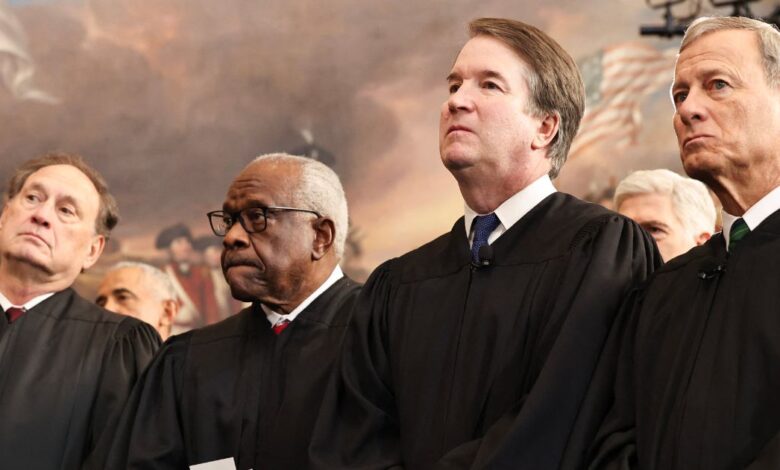
Liberals are getting nervous about November’s midterm elections after the Supreme Court handed Republicans a huge victory, which could signal how the justices might rule on a pending Voting Rights Act issue.
On Monday night, the high court ruled on a gerrymandering case and paused a lower court order that would have required New York state to redraw its congressional maps in an effort to aid black and Latino voters, according to SCOTUS Blog.
Justice Samuel Alito wrote a concurring opinion to the unsigned emergency order, calling the original ruling “unadorned racial discrimination.”
This is a massive victory for Republicans in more ways than one.
Not only does it preserve New York’s 11th congressional district — the only district in New York City held by Republicans — but it also hints that the Supreme Court may be inclined to strike down part of the Voting Rights Act.
Such a ruling would eliminate race-based districts and, with it, a significant number of Democratic seats in the House.
The New York Times was forced to admit that the most recent ruling was a “Republican win,” but the liberal panic was only beginning to set in.
The real fear emerged later in the article, when the authors linked it to the case of Louisiana v. Callais.
The main question in that case is whether Louisiana violated the Constitution when it created a second majority-minority district.
If the answer is “yes,” it would “scramble the country’s congressional maps,” the article noted.
Another far-left outlet, Mother Jones, published an article about how the high court’s New York district decision could have far-reaching implications.
“Alito is essentially saying that districts drawn under the Voting Rights Act or other federal and state laws to remedy centuries of racial discrimination are as racist as the racism (including the legacy of slavery and Jim Crow) they were meant to rectify,” the piece said.
The 2026 Senate and gubernatorial maps currently favor Republicans.
Democrats’ only chance of stopping President Donald Trump’s agenda is to take back the House of Representatives.
If the Supreme Court rules that raced-based districts are no longer needed to achieve equality and strikes down that provision of the Voting Rights Act, it would be a major blow to the liberal agenda.
It might take years for the party to recover any real power in D.C., given how favorable the 2028 Senate map looks for the Republicans.
Democrats also lack a true leader. No one candidate has emerged to challenge presumptive frontrunner Vice President J.D. Vance.
CNN’s chief data analyst Harry Enten called the 2028 field of Democratic presidential hopefuls “a mess” just one week ago, according to HuffPost.
“This is just a downright clown car at this point on the Democratic side,” he said.
Justice Brett Kavanaugh, a Trump appointee, got media attention for his comments during oral arguments for Louisiana v. Callais late last year. He said race-based districts have been in place for decades to restore equality, yet there’s still no end in sight.
“The issue, as you know, is that this court’s cases in a variety of contexts have said that race-based remedies are permissible for a period of time,” he said, per CNN. “Sometimes for a long period of time, decades in some cases. But that they should not be indefinite and should have an end point.”
CNN host Dana Bash said back in October, “This ruling has the potential to undermine, if not completely overturn, a core provision of the Voting Rights Act, intended to ensure black voters have adequate representation.”
CNN’s Washington Bureau Chief David Chalian said if the court sides with the GOP, it could create a “permanent advantage for Republicans in building an enduring majority.”
Even Chief Justice John Roberts, a swing vote, said: “The way to stop discrimination based on race is to stop discriminating based on race.”
It seems clear that the Supreme Court is leaning toward ending the practice of raced-based congressional districts, because the law has done its job. This provision of the Voting Rights Act has been in place since 1965. That’s over 60 years.
When will it end?
Furthermore, isn’t it the stated goal of racial equality advocates to not be judged by the color of their skin, but by the content of their character? Given the chance, Democrats would likely allow the law to stay in place forever, while telling the public they only need a few more years to achieve perfect racial harmony.
But this long con, it seems, is finally coming to an end.
As the 2026 midterms inch closer and closer, Democratic lawmakers should listen to the bell, because “it tolls for thee.”