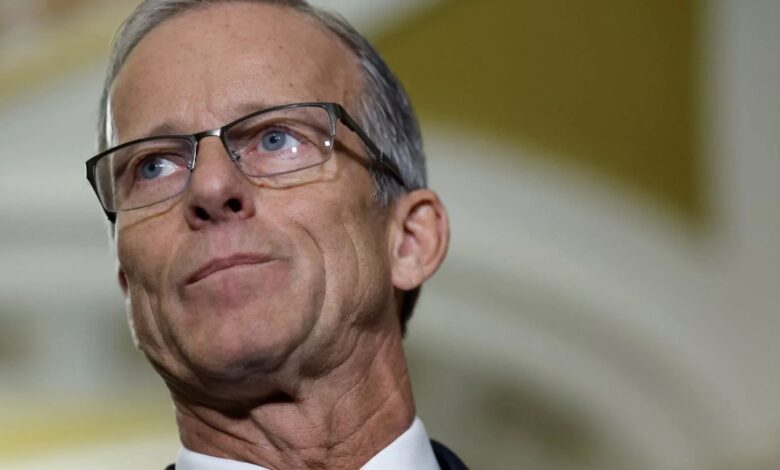
(Puck) Last week, I came across Senate Majority Leader John Thune in a quiet marble stairwell, talking animatedly on the phone—a rare sight considering the quick-moving Republican leader doesn’t often conduct business in public. “If it’s not going to us, it’s going to China or Russia,” he said, sounding like he was trying to match the energy on the other end of the line. It was the morning of the Senate’s war powers vote on Venezuela, which Trump was watching closely, and Thune would soon be getting a much less cordial phone call. After five Republican senators voted to advance the resolution limiting the president’s use of force in Venezuela, Thune had a furious president on the line.
Therein lies the challenge for the new, affable leader who has arguably the most difficult job on Capitol Hill—protecting his conference, his majority, and the Senate against a vengeful president who attacks politically vulnerable members and has no taste for norms or tradition. It’s an unenviable position, especially because Thune is simultaneously contending with the personal agendas of 52 fellow Republican senators. “I don’t think anyone could do it better,” one Republican Senate chief of staff told me.
Trump detests Congress, which he sees as a nuisance, and he especially dislikes the Senate, which is harder to control, slower, and more obstinate than the House. The House, after all, is more closely tied to the president’s fortunes and falls much more easily in line. Speaker Mike Johnson won his job because of Trump, and has kept it because of Trump—even though a growing number of members are becoming disenchanted with Johnson’s leadership.
Of course, Thune is under a tremendous amount of pressure to placate Trump as well. But unlike Johnson, he doesn’t owe his leadership position to Trump, who also can’t as easily cajole longer-tenured (or soon-retiring) senators. Sen. Thom Tillis of North Carolina, for example, is not running for reelection and feels unshackled from Trump’s politics of retribution. Sen. Lisa Murkowski of Alaska has already won in her beet-red state with the full force of the Trump political machine working against her. And Sen. Rand Paul, a known quantity in quirky Kentucky, hasn’t abandoned his limited-government, anti-interventionist core to adapt to Trump’s fluctuating principles.
So unlike Johnson, Thune has to spend a significant amount of time trying to explain the competing objectives and incentives of his headstrong members to someone without a lot of patience. “He has worked hard to get the president to trust him,” Sen. John Kennedy, a Louisiana Republican, told me. (Thune’s office declined to comment for this story.)
Getting his conference to trust him can be more difficult, particularly when Thune can’t hide the fact that he’s carrying water for Trump. But passion helps. Last year, trying to overcome Democrats’ delay tactics in confirming the president’s political appointees, Thune’s infectious anger helped persuade his reluctant members to get behind a rule change to allow a large number of appointees to move forward on one vote. (Even before that, the Senate had actually confirmed a near-record number of nominees compared to previous presidents. After the rule change, the confirmations have far surpassed those of other administrations.)
Republican senators are less enthusiastic about Thune’s fondness for keeping the Senate in for long hours, including adding Friday votes at the last minute, for the sake of Trump’s “more, faster” agenda. One senior Senate Republican aide told me that senators have had to cancel an “extraordinary” number of fundraising events to accommodate Thune’s timetable. In fact, the brutality of the Senate schedule was a big factor in freshman Sen. Cynthia Lummis’s surprise decision to not run for reelection in Wyoming, according to someone who has heard Lummis explain her reasoning.
Thune notched another victory for Trump just tonight, when the Senate voted down the very war powers resolution that so infuriated the president when it advanced last week. At the White House’s urging, Senate leadership successfully convinced two of the five G.O.P. defectors who had voted to move it forward—Sens. Josh Hawley and Todd Young—to flip their votes and kill it.
Schumer’s Spoilers
Still, Thune doesn’t always give Trump what he wants. Last fall, during the government shutdown, Trump became so frustrated with the Senate’s inability to come up with the needed 60 votes to fund the government that he publicly pressured the majority leader to get rid of the filibuster—despite Thune’s public and private insistence to the president that his conference wouldn’t go for it. Aides from the White House Office of Legislative Affairs wasted endless hours in December meeting with senators and staff to push the idea, arguing that the Democrats would kill the filibuster anyway the moment they reclaimed the Senate. For now, that campaign has died down—as one Republican senator told me, “I think they’ve heard enough to know that there’s just not enough votes.”
Indeed, telling Trump he’s not allowed to simply get rid of everything he hates about Washington often falls to Thune—who, for example, has had to temper the president’s determination to eliminate the so-called “blue slip,” a 100-year-old “senatorial courtesy” that gives the minority party a say in judicial nominees from their own states. Making Thune’s job a little easier: Republican Sen. Chuck Grassley, the staunch 92-year-old chair of the Judiciary Committee, is defiant in protecting the mechanism.
Meanwhile, Trump is making it harder for Thune to maintain his Senate majority—especially given the public’s continuing gloom about the economy, growing outrage over ICE tactics, and increasing disapproval of Trump himself. Trump did him no favors last week when he publicly lashed out at Collins for voting to advance the war powers resolution, telling supporters she should never be reelected—thereby gratifying Democrats, who see her seat as a prime pickup opportunity and essential to flipping the Senate. Thune will “continue to make the case” to Trump “that if you want a strong Senate majority, it runs through Susan Collins in Maine,” a person familiar with his thinking said. Democrats have been making moves of their own: Senate Minority Leader Chuck Schumer has recruited impressive candidates like Roy Cooper, Sherrod Brown, Janet Mills, and Mary Peltola, who may further complicate Thune’s midterm hopes.
But of course, Thune’s not the only Hill Republican with Trump-induced heartburn. The president recently echoed Sen. Elizabeth Warren’s call for a 10 percent cap on credit card fees, which is causing some hyperventilation on Wall Street. And when Trump’s Justice Department launched a criminal investigation into Federal Reserve Chair Jerome Powell, hardly any members spoke up to defend what appears to be a thinly veiled threat against the central bank’s independence. (Thune, always searching for a way to thread a needle between his conference and the president, said the allegations “better be real and they better be serious.”) “I think John’s been a good majority leader,” Sen. Lindsey Graham told me. “He’s really helped push the president’s agenda. But there are some things the president will want that he’s just not going to get.”